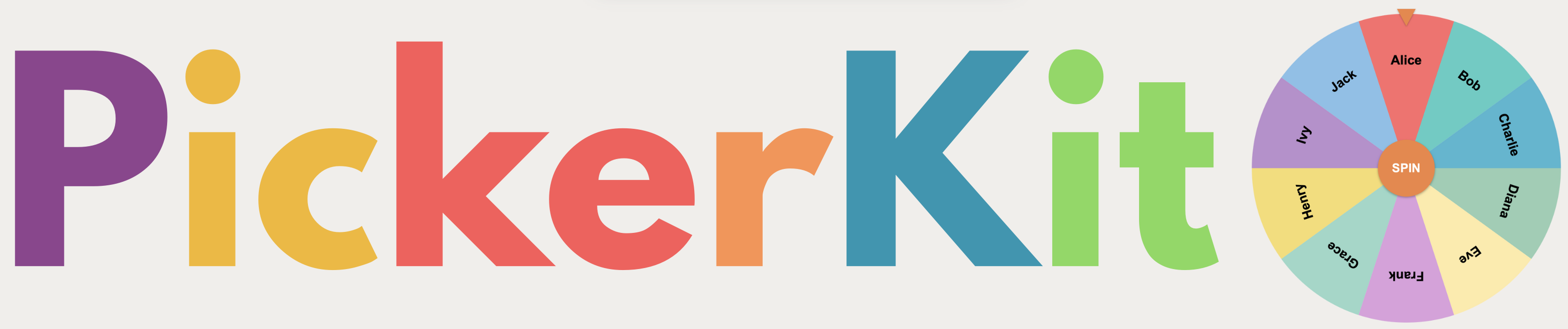
PickerKit uses the browser’s Web Crypto API when available and a standard browser random fallback otherwise. Equal-sized wheel slices receive equal probability. The tools are intended for ordinary picker workflows, not security-critical or regulated decisions.
What most people mean by “random”
In practice, users usually mean two things: “I could not predict the result” and “nobody could secretly steer the result.” That is a stronger standard than “it looks random enough.” PickerKit is built around the first standard, because fairness matters more than cosmetics in classrooms, giveaways, and team assignments.
Why secure randomness matters
Some simple random tools rely on lightweight pseudo-random functions that are fine for toy use cases but not ideal when trust matters. PickerKit instead uses the browser’s secure randomness APIs, which are designed for unpredictability.
You do not need to understand the low-level implementation to benefit from it. The practical takeaway is simple: the picker result is not based on a visible wheel position that a person can game. The result comes from a proper random draw first, and the wheel animation exists to communicate that outcome.
Why streaks do not mean the tool is broken
People often expect randomness to “look evenly mixed” in the short term. Real randomness does not behave that way. You can get the same result several times in a row. A student can be picked twice close together. “Yes” can land multiple times back to back. That feels suspicious, but it is normal.
- Random does not mean alternating.
- Random does not guarantee short-term balance.
- Random means each draw has the intended probability.
How fairness shows up in the product
| Concern | How PickerKit addresses it |
|---|---|
| Can the user steer the wheel? | The result comes from the random draw, not a manual stop. |
| Can everyone see the options? | The wheel displays the entries visibly before the spin. |
| Can repeated winners happen? | Yes, unless the user removes each winner after selection. |
How to verify a picker before an important draw
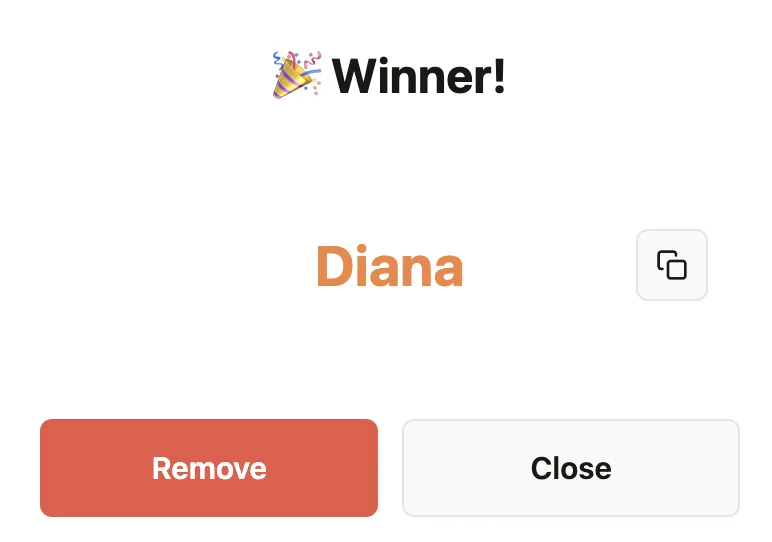
Load a short test list, spin several times, and test the winner dialog's Remove action. Then open a generated share link to confirm the same list and settings return. For a public draw, rehearse before the audience arrives and use a fresh final list for the real selection.
Random selection and no-repeat selection are different
Each spin is independent while an entry remains on the wheel, so the same person can be selected again. When a process requires one winner per prize, one student per turn, or one presenter per slot, use the result popup's Remove action before spinning again. That changes the remaining list for the next draw; it does not make the original spin more or less random. State the rule before the first spin so everyone knows whether repeat results are possible.
Equal chances start with equal entries
When every option appears once, each option has the same chance on that spin. Repeating an entry gives that label more than one possible slot, which is appropriate only when your published rules deliberately allow multiple entries. For a classroom roster or one-person-one-prize draw, clean duplicates out before loading the list. For a weighted promotion, keep the source list and its weighting rule available so participants can understand why some labels appear more than once.
Readers who are ready to choose a tool should continue to the PickerKit comparison page or the giveaway workflow guide.
Ready to make the selection?
Open the relevant picker, add the final list or range, and use the process described above.
Frequently Asked Questions
Is PickerKit really random?
It uses the browser’s secure random APIs, which are intended for unpredictability and are stronger than simple pseudo-random utilities.
Why do streaks still happen?
Because independent random draws can still produce clusters and streaks. Repetition is not proof of bias by itself.
Can users manipulate the wheel outcome?
The visible wheel animation is presentation. The underlying result is generated by the random function, not by where a user tries to stop the animation.
Why does fairness matter so much?
Because most picker use cases are social. People need to trust the result enough to move on without debating the process.